There is a particular kind of Christmas decoration that has quietly vanished from polite society. You don’t see it in lifestyle magazines or carefully curated Instagram grids. It lives instead in memory: slightly faded, slightly torn, faintly smelling of loft dust and whatever the 80s were made of.
I am talking about paper chains, ceiling tinsel, those deeply unsettling Santa door posters, and the general category we might call “decorative nonsense”. The stuff that never matched, never coordinated, and never once appeared in a mood board, yet somehow made a room feel absolutely, unequivocally Christmas.
Somewhere between childhood and adult respectability, we agreed to pretend that these things were tacky, embarrassing, or “a bit much”. We replaced them with muted colour palettes, warm white fairy lights, and trees that look like they’ve been designed by a Scandinavian who bills by the hour. I understand why we did it. I also quietly resent it.
Paper Chains: Our First Lesson in Pointlessness
Paper chains were, in hindsight, an educational activity disguised as craft. You sat at a table with a glue stick that didn’t quite work, a pile of coloured strips, and the naive optimism of someone who thought this would be fun.
You made the first few loops carefully, then realised you had committed yourself to another 198 of them. The glue dried at the wrong time. The strips stuck to your fingers but not to each other. The whole thing slowly twisted into a symbolic representation of effort without reward.
And yet, when you finally draped that sagging, uneven chain across the room, it transformed the space. Not into anything tasteful, obviously. But into something intentional. Someone had tried. Someone had sat there and made this utterly unnecessary object, purely for the sake of making it.
Adults do not make many things that are allowed to be useless. We write emails, assemble flat-pack furniture, complete spreadsheets, cook meals that are judged on nutritional content and presentation. The last time most of us created anything whose sole job was “hang there and look pleased with itself” was probably a paper chain.
Perhaps that’s why we remember them so fondly. They were proof that we once had time to loop coloured paper into a fragile, temporary universe and call it important.
Ceiling Tinsel and the Geometry of Wonder
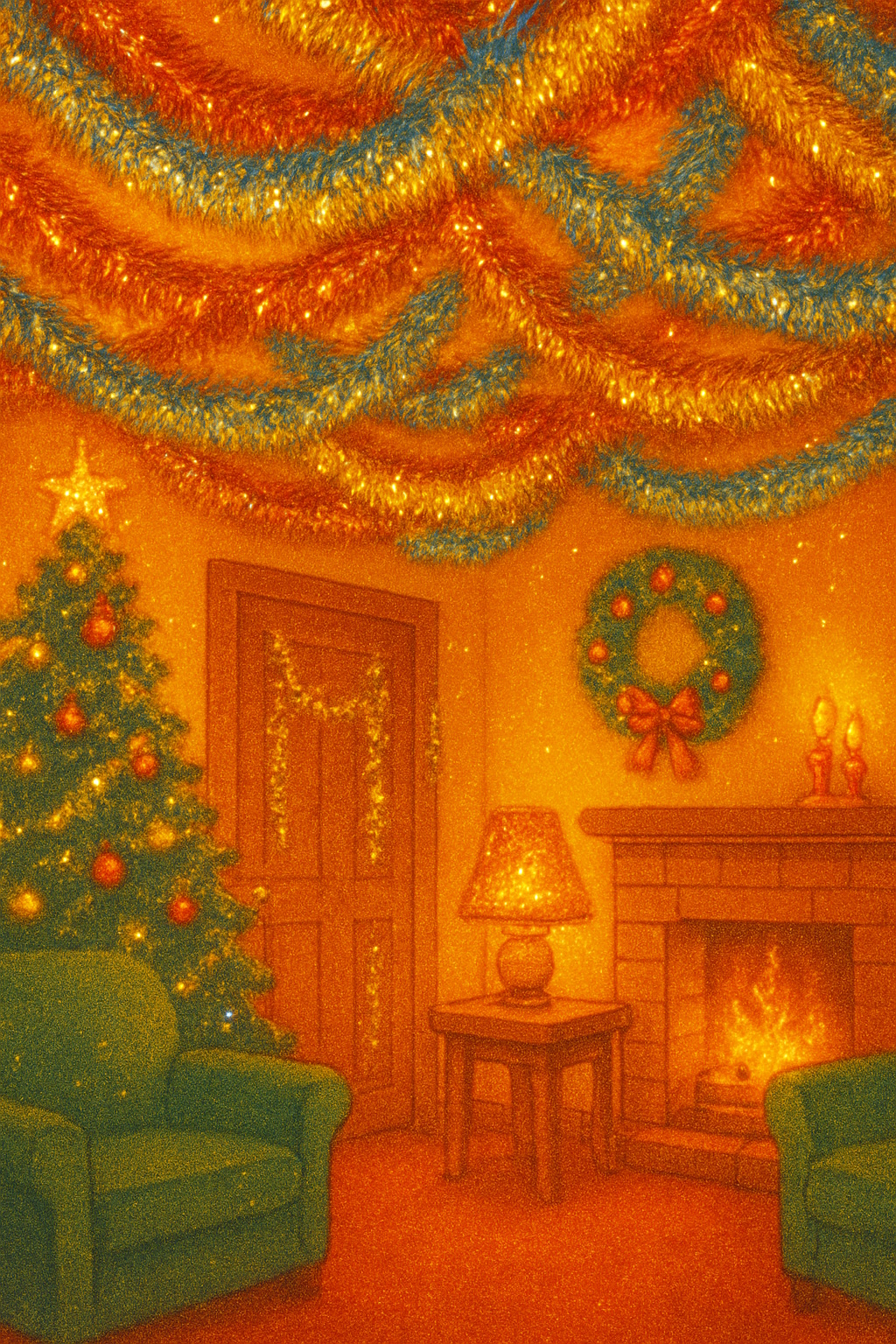
Ceiling tinsel was an act of architectural ambition. You didn’t just hang it; you engineered it. Four corners of the room, one central point, drawing everything in like a glittery black hole.
Pinned just slightly too high to reach comfortably, the strands sagged in exactly the wrong places. Some houses layered multiple colours: gold over red over green, crossing at awkward angles until the room looked like it had been gift‑wrapped by an enthusiastic but easily distracted spider.
Was it elegant? Absolutely not. Did it obey any known principle of interior design? Also no. But lying on the carpet and looking up at that improvised constellation in the half‑dark, with the telly murmuring in the background and the smell of something vaguely festive in the oven, felt oddly profound.
Modern decorations tend to be vertical: trees in corners, garlands on mantels, tasteful things standing quietly where they’ve been told. Old‑style tinsel was horizontal. It insisted on being overhead, in your line of sight, demanding that you look up.
Now we have recessed spotlights and Instagrammable pendant bulbs. They illuminate everything, but very rarely invite wonder. Ceiling tinsel was impractical, mildly hazardous, and entirely unnecessary. It was also, in its own messy way, a kind of domestic cathedral roof made out of plastic.
The Santa Door Poster: Accidental Surrealism
If you grew up in a certain era, there is a good chance your front door, or possibly your living‑room door, was once covered by a full‑length Santa poster.
His face was never quite right. The eyes were either too friendly or not friendly at all. The beard looked less like hair and more like an unexplained texture. The colours were aggressively wrong: red that glowed like it had been printed by a nuclear power station, white that was never truly white, but a sort of nicotine‑adjacent cream.
And yet he was there, every year, taped to the door, creased along the middle from where he had been folded into four and shoved in the Christmas box with the spare fairy lights and the angel with the bent halo.
Looking back, these posters were our first encounter with cheap surrealism. A large, badly printed stranger loomed over the hallway, smiling with the haunted cheerfulness of someone who knows they will spend eleven months in a loft.
We did not question this. We accepted that during December, the door belonged to him. Somewhere along the line, though, we decided that grown‑up homes do not have human‑sized Santas stapled to internal doors. We replaced him with wreaths that match the door colour and say tasteful things about our personal brand.
I suspect the door is bored.
Glitter, Tinsel, and the Acceptable Mess
Glitter decorations taught us two things:
First, that beauty leaves residue. Second, that no matter how thoroughly you think you’ve cleaned, there will always be one more sparkly speck on your cheek at a job interview in March.
There is something oddly comforting about that. Glitter is evidence that something joyful happened in the past and has refused to fully leave. It is the physical manifestation of a memory that keeps turning up long after the event, quietly reminding you that life was once louder and sillier.
Tinsel operates on a similar principle. No one actually needs it. It doesn’t serve a purpose beyond “attach self to object, look festive, shed occasionally”. It frays. It fades. It arrives from the shop in a pristine coil and leaves your house three years later as a small, flat, quietly exhausted snake.
We used to drape it over everything: TVs, photo frames, lamps, that one photo of a relative no one could identify. Now, in the age of minimalist decor, tinsel has been quietly moved to the box marked “for kids’ rooms” or “maybe next year”.
I am not entirely sure that a world with less tinsel is an improvement.
When Christmas Became Tasteful
At some point – and I don’t remember being consulted – Christmas decorations became stylish.
Trees went monochrome. Baubles came in curated sets. Someone invented the phrase “accent colour” and decided it applied to pine. Fairy lights shifted from multicoloured chaos to warm white restraint. Mantelpieces turned into lifestyle spreads: eucalyptus, candles in jars, three pine cones placed with mathematical precision.
None of this is bad, exactly. Many of these homes look beautiful. But they also look like they are waiting to be photographed rather than lived in.
The old decorations didn’t care how they appeared to strangers. They were not designed for visitors or social media. They were there for the people who lived in the house, to make the lounge feel less like the place you did your homework and more like the place where time briefly bent in a hopeful direction.
A tastefully decorated Christmas is something you admire. A gloriously cluttered, slightly ridiculous one is something you inhabit.
Joy, Taste, and Growing Out of Things
If you strip all the plastic and glitter away, what sits underneath this whole conversation is a simple, slightly uncomfortable question:
When did we decide that joy had to be tasteful?
Children do not care about aesthetic cohesion. They care that the thing is bright, that it sparkles, that it looks like effort. They care that the same odd decorations appear year after year, gaining meaning simply by refusing to die.
Somewhere along the way, most of us internalised the idea that growing up means smoothing the edges. We talk about “decluttering” and “refining our style” and “investing in timeless pieces”. None of these phrases belong anywhere near a Santa door poster.
Maybe part of being an adult is pretending that we do not miss the things we have outgrown. Maybe another part is quietly admitting that we do.
A Small, Secret Wish
I am not campaigning for a full return to ceiling tinsel and radioactive Santa faces. I understand that fire regulations exist, that ceilings are high, and that many of us now have light fittings that would lose a fight with a drawing pin.
But there is a small, stubborn part of me that would like, just once, to walk into a room and see paper chains again – not as a retro joke, not as ironic nostalgia, but as a genuine attempt to make the space feel special.
I would like to see tinsel draped over something it has no business being on. I would like to see a decoration that clashes with everything around it and is loved precisely because it was made by a small, sticky hand fifteen years ago.
I would like Christmas to look, unapologetically, like humans live here.
Because perhaps the real magic was never in the decorations themselves, but in the moment we all agreed, without question, that a badly glued paper chain and a crooked bit of ceiling tinsel were enough to turn an ordinary room into a place where, for a little while, everything felt softer and somehow brighter.


James Henshaw is a brooding Geordie export who swapped the industrial grit of Newcastle for the peculiar calm of Lincolnshire—though he’s yet to fully trust the flatness. With a mind as sharp as a stiletto and a penchant for science-tinged musings, James blends the surreal with the everyday, crafting blogs that feel like the lovechild of a physics textbook and a fever dream.
Equally at home dissecting the absurdities of modern life as he is explaining quantum theory with alarming metaphors, James writes with the wit of someone who knows too much and the irreverence of someone who doesn’t care. His posts are infused with a dark humour that dares you to laugh at the strange, the inexplicable, and the occasionally terrifying truths of the universe—whether it’s the unnerving accuracy of Alexa or the existential menace of wasps.
A figure of mystery with a slightly unsettling edge, James is the sort of bloke who’d explain the meaning of life over a pint, but only after a dramatic pause long enough to make you question your own existence. His wit cuts deep, his insights are sharp, and his ability to make the surreal feel strangely plausible keeps readers coming back for more.
Discover more from untypicable
Subscribe to get the latest posts sent to your email.