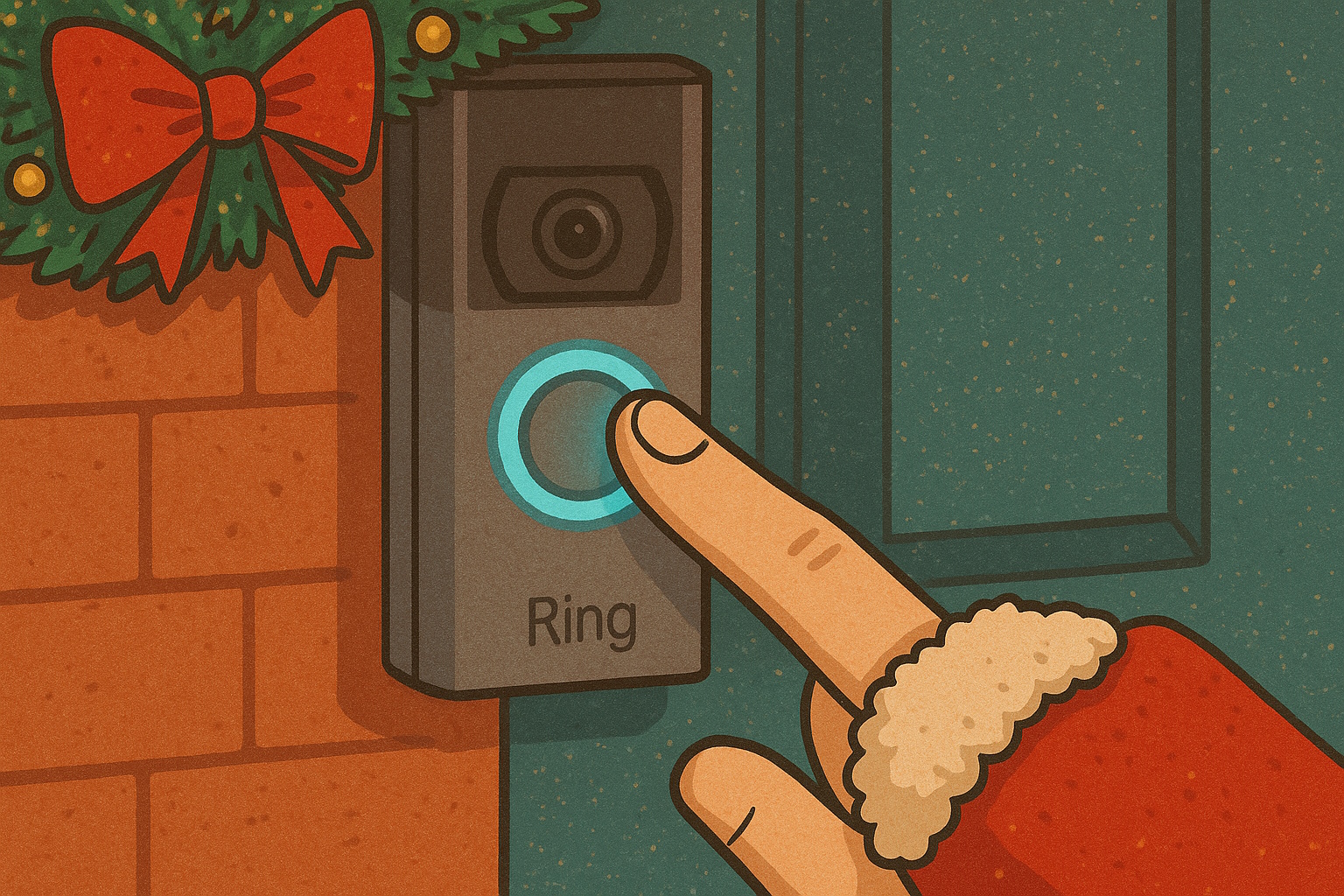
December is parcel season. For most households, that means cardboard, deliveries, and mild worry about whether the neighbours have noticed how often the vans appear.
For ours, it means something else entirely: the shih-poo and the cockerpoo have entered their busy period.
The shih-poo is an adult male with the soul of a retired headteacher. He believes in order, routine, and being the first to know about everything that happens within a 50-metre radius of his garden. The cockerpoo is a female puppy whose hobbies include joy, chaos, and chewing USB cables as if she’s trying to bring down the entire digital economy.
Between them, fixed by the back door that leads out into the garden, sits the Ring doorbell — a small piece of plastic that has somehow become the centre of their world.
The First Chime
The first time the Ring doorbell went off in December, I was in the kitchen, standing between a pan of half-committed gravy and a stack of presents I’d sworn I would wrap “properly this year”.
The familiar chime sounded: a polite digital ding-dong that, in theory, lets you calmly check who’s outside via your phone.
In practice, it triggers this:
The shih-poo launches off his bed with military urgency, nails ticking on the tiles as he charges towards the back door, barking in full caps lock. The cockerpoo detonates into kitchen cardio, doing frantic laps around the table and island like a small, furry particle escaping a collider.
By the time I’ve put the spoon down, both dogs are at the back door. The shih-poo has planted himself directly in front of it, tail up, eyes bright, conducting a full security assessment of the known universe. The cockerpoo, powered by excitement and zero braking capacity, sprints straight into the bottom of the door with an audible thunk, reverses half a step, and pretends nothing happened.
The Ring app, ever cheerful, pops up to inform me: “Someone’s at your back door,” as if this is a manageable situation.
Christmas, as Understood by a Shih-Poo
From the shih-poo’s point of view, Christmas is essentially a logistics problem. The back door is the border, and the Ring is the alert system.
When the chime sounds, he heads for the back door with the air of a man who’s just been told Ofsted are in the car park. Outside might be a delivery driver, a neighbour, a hedgehog committing crimes, or a pigeon loitering suspiciously on the fence.
It doesn’t matter what’s being delivered. He’s not interested in the contents. He is interested in process. He inspects. He sniffs. He barks a full report. He ensures that everyone — including the sparrows — knows that he is on duty.
He is, in his mind, Head of Back-Door Security. I am the admin assistant.
Christmas, as Lived by a Cockerpoo Puppy
The cockerpoo sees things differently. For her, the Ring chime is magic. She’s still young enough to believe that every sound at the back door is a personal visit from destiny.
Her internal narrative goes something like this:
Bell.
Person.
Friend.
Back door.
Oops.
Try again.
She adores the garden. She adores people. She adores anything that moves, rustles, or even thinks about being edible. At Christmas, the combination of parcels, relatives, and random outdoor activity turns the back door into her favourite theatre.
And then there are the cables.
While the shih-poo is staring intently through the glass, giving his professional verdict on whoever or whatever has dared to approach the garden, she is quietly scouting the skirting boards and sockets for unattended USB cables.
If one has been left dangling like low-hanging technological fruit, she’ll gently unhook it, carry it to her bed, and begin the delicate work of turning it from “perfectly functional charging lead” into “very expensive piece of modern art shaped like regret”.
I have learned, over time, to recognise the precise silence that means she’s got another one.
The Ring as Interactive Advent Calendar
For the dogs, the Ring isn’t just a doorbell; it’s an interactive Advent calendar, specifically calibrated to the back of the house.
Every alert is a new window into Dog Television:
A delivery driver appears at the gate, shoulders hunched against the rain, balancing three parcels and his will to live. The shih-poo barks in professional tones; the cockerpoo bounces, convinced he’s come to audition for her fan club.
A neighbour pops their head round to ask about bins. Both dogs rush to the back door, offer advice, and smear nose prints on the glass.
A hedgehog waddles across the patio at 2am. The Ring captures it in eerie night vision. The shih-poo files a formal complaint with the universe. The cockerpoo, having slept through it, spends breakfast barking at the replay.
A leaf flutters past. The Ring senses “motion”. Both dogs treat it as a full-scale breach.
Every ding has potential. In a month where humans see a never-ending to-do list, the dogs see a never-ending series of exciting episodes.
Opening the Back Door
By the time I actually reach the back door, the shih-poo is stationed directly in front of it, posture perfect, vibrational anxiety set to Medium-High. The cockerpoo is oscillating between a wobbly sit and launching herself at the door in case it’s forgotten that she exists.
I slide the key, open the door, and there it is: the standard British December back-door scene. A delivery driver in hi-vis, already halfway back up the path. A neighbour with a card. A family member holding Tupperware and looking slightly wind-blown.
The shih-poo leans forward to inhale their entire biography. The cockerpoo wriggles, determined to greet, befriend, and ideally get inside any bag that might contain food or, failing that, another cable.
I mumble the usual apologetic script:
“Hi! Sorry, they’re very excited. Yes, she did run into the door. Yes, he always looks that way. Yes, they are friendly. Eventually.”
Somehow, everyone smiles. It’s hard not to, with two dogs auditioning for the role of Festive Welcome Committee.
Life Behind the House, Post-Chime
Once the visitor has gone and the back door is shut, the kitchen slowly exhales. The shih-poo does a final circuit to check the garden is still where he left it. The cockerpoo returns to hoovering the floor for imaginary crumbs and casting speculative glances at the plug sockets for the next tasty USB-related snack.
For a moment, things calm down. The gravy is reclaimed. The presents eye me reproachfully from the table. I tell myself that next year I will definitely train them to respond calmly to the doorbell.
Then the Ring chimes again, because it’s Christmas, and parcels reproduce when your back is turned.
The shih-poo is on his feet instantly.
The cockerpoo launches into another set of kitchen zoomies, rounds the table, misjudges her stopping distance, and bounces off the back door like a rubber ball in festive pyjamas.
The app flashes up its familiar message: “Someone’s at your back door.”
I do not need telling.
Why I Secretly Love It
On paper, it’s a lot. The kitchen tiles carry the faint scuff marks of panicked paws. The back door is a gallery of nose art. I’ve bought more replacement USB cables this year than actual presents.
But the way the dogs react to that chime — especially at this time of year — is oddly contagious.
Where I hear another interruption, they hear possibility. Where I see another delivery to stash somewhere and forget about, they see the thrilling arrival of a new character. Where I hear the cold logic of a notification, they hear magic.
Someone is out there.
Something is happening.


AJ Wright is a quiet yet incisive voice navigating the surreal world of sociology, higher education, and modern life through the unique lens of a neurodivergent mind. A tech-savvy PhD student hailing from South Yorkshire but now stationed in the flatlands of Lincolnshire, AJ writes with an irreverence that strips back the layers of academia, social norms, and the absurdities of daily life to reveal the humour lurking beneath.
As an autistic thinker, AJ’s perspective offers readers a rare blend of precision, curiosity, and wit. From dissecting the unspoken rituals of academia—like the silent war over the office thermostat—to exploring the sociology of “neurotypical small talk” and the bizarre hierarchies of campus coffee queues, AJ turns the ordinary into something both profound and hilarious.
AJ’s unassuming nature belies the sharpness of their commentary, which dives deep into the intersections of neurodiversity, tech culture, and the often-overlooked quirks of human behaviour. Whether questioning why university bureaucracy feels designed by Kafka or crafting surreal parodies of academic peer reviews, AJ writes with a balance of quiet intensity and playful absurdity that keeps readers coming back for more.
For those seeking a blog that is equal parts insightful, irreverent, and refreshingly authentic, AJ Wright provides a unique perspective that celebrates neurodiversity while poking fun at the peculiarities of the world we live in. Also a contributor at Thinking Sociologically.
Discover more from untypicable.
Subscribe to get the latest posts sent to your email.