by Dwight Warner
Group chats are the modern equivalent of shared housing: cramped, chaotic, impossible to leave without causing offence, and haunted by the constant possibility that someone will add a stranger (or a journalist, if you are a US National Security Advisor) without warning.
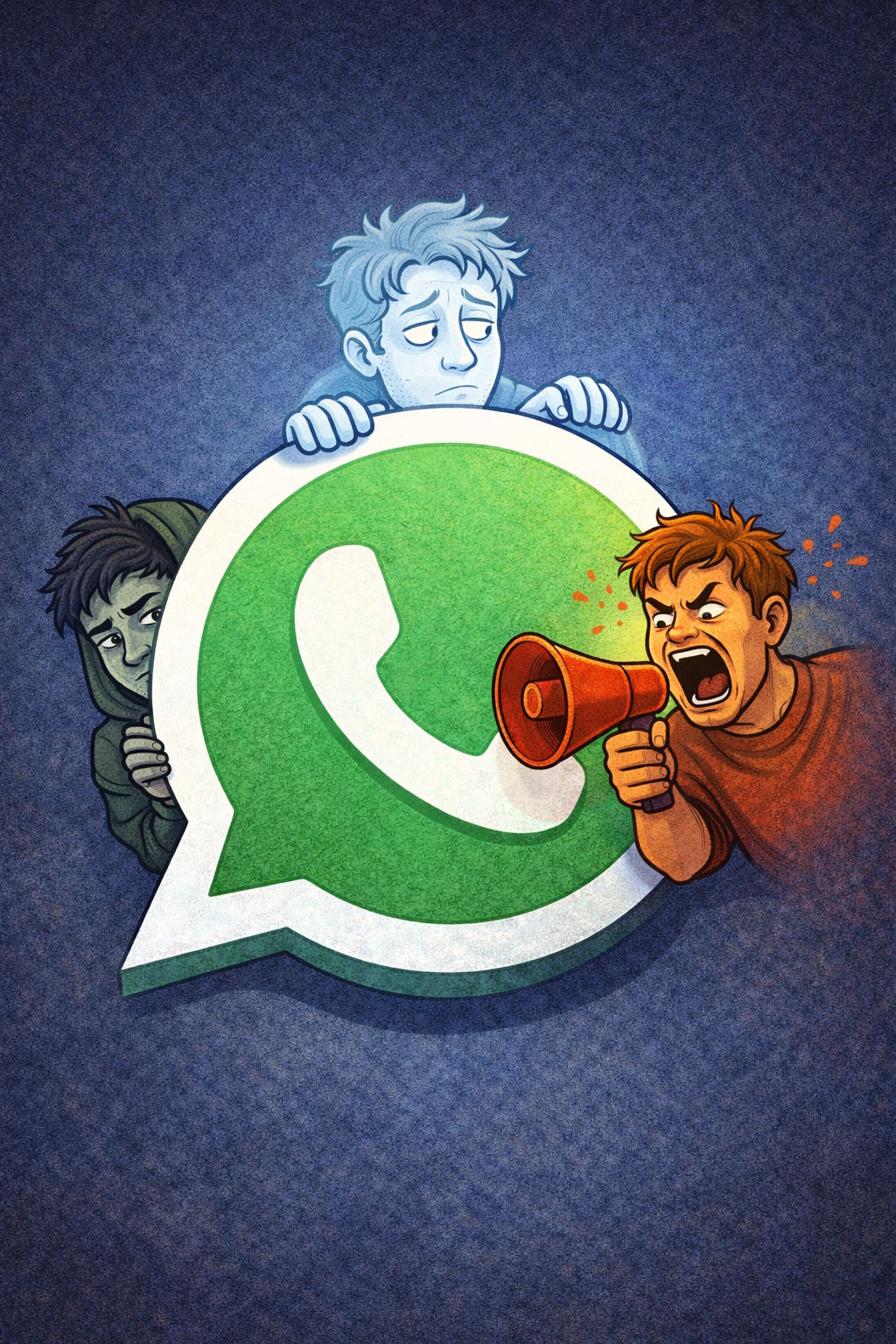
They are also, in their own glitchy way, the purest expression of friendship. Which is why every group chat, regardless of demographic, platform, or purpose, inevitably evolves the same three archetypes: The Ghost, The Shouter, and The Lurker. Additional subspecies exist, but these three are the keystone species that prevent total collapse.
Let us begin the autopsy.
The Ghost
The Ghost is technically a member of the group, in the same way that a hermit crab is technically part of an ecosystem. They appear once every 14–18 months, usually to ask a logistical question (“What time is the train?”), and then vanish before anyone can reply.
The Ghost reads everything. We know this because their read receipts are visible, their presence is felt, and occasionally they react to a message with a single emoji five days late — a timid flare shot into the night sky.
The Ghost disproves the long‑held assumption that participation is required for belonging. It is not. Observation is sufficient. The Ghost is simply doing ethnography.
The Shouter
Where the Ghost contributes nothing, the Shouter contributes everything, loudly, and usually in one massive block of unpunctuated text arriving during work hours.
The Shouter uses the group chat as a personal broadcast channel. They make announcements. They narrate their commute. They break news stories that are already on the BBC homepage. They send voice notes that no one listens to because voice notes are a communication format invented by sadists.
The Shouter is bafflingly unembarrassed by the concept of attention. They also believe that a group chat is the correct venue for processing emotions in real time, which is both admirable and deeply inconvenient.
The Lurker
The Lurker is not to be confused with The Ghost. The Ghost disappears entirely. The Lurker is always there — silently watching, silently judging, silently screenshotting. Their presence is a low hum in the digital background.
The Lurker occasionally reacts with a thumbs‑up or a crying‑laughing face, which is just enough to remind the group that they still exist. They do not start conversations. They do not escalate conflict. They simply wait for the correct moment to send a single devastating message like:
“Lol.”
The Lurker proves that the line between involvement and surveillance is hazy at best.
Minor Subspecies (Honourable Mentions)
Biodiversity is important, so we must acknowledge the supporting cast:
The Planner – Creates polls, schedules events, produces timetables. Receives zero replies for 72 hours and then one “yeah sounds good” from someone who didn’t read the message.
The Meme Distributor – Contributes nothing but perfectly timed memes. Culturally vital.
The IT Department – Knows how to mute threads, clear cache, export chat history, and back up 2,800 images of dogs and brunch.
The New Recruit – Added without warning. Spends three weeks observing group politics like a junior diplomat before attempting their first meme.
A Field Scenario
To illustrate the dynamic, consider the most volatile sentence known to messaging applications:
“Shall we meet up soon?”
Reactions, in the wild:
- Ghost – Seen 08:14, no reply.
- Shouter – “YES LET’S DO IT THIS WEEKEND!!!”
- Lurker – Nothing.
- Planner – “I’ve created a poll with dates and venues. Please respond by Thursday.”
- Meme Distributor – Sends GIF of raccoon holding wine.
- New Recruit – Types “haha yes” and instantly regrets it.
- IT Department – Repairs the poll.
Outcome: no one meets up.
The Diagnostic Test
Which one are you? A simple test:
A message arrives during work hours. It contains 137 unread replies. Your instinct is to:
A) Mark as read and say nothing (Ghost)
B) Reply to every thread individually (Shouter)
C) React with emojis at 11pm (Lurker)
D) Produce a spreadsheet (Planner)
E) Send meme (Meme Distributor)
F) Mute for one year (IT Department)
If none of these apply, you are The New Recruit.
Closing Remarks
Group chats are friendship distilled to its most chaotic form. They contain love, neglect, noise, diplomacy, and a worrying amount of passive aggression. They are sustained by inertia and nostalgia. They endure because logging out feels rude and deleting the chat suggests emotional instability.
Most importantly, they prove that social order persists even in digital environments that should, by all rights, collapse.
We all believe we are the sensible one. In reality, we are someone else’s Shouter.


Dwight Warner is the quintessential oddball Brit, with a weirdly American-sounding name, who has a knack for turning the mundane into the extraordinary. Hailing originally from London, now living in the sleepy depths of Lincolnshire but claiming an allegiance to the absurd, Dwight has perfected the art of finding the surreal in real life. Whether it’s a spirited rant about the philosophical implications of queueing or a deep dive into why tea tastes better in a mug older than you, his blogs blur the line between the abstract and the everyday.
With an irreverent wit and a penchant for tangents that somehow come full circle, Dwight Warner doesn’t just write; he performs on the page. His humour is both sharp and delightfully nonsensical, like Monty Python met your nosiest neighbour and they decided to co-write a diary.
Known for being gregarious, Dwight is the life of any (real or metaphorical) party, whether he’s deconstructing the existential crisis of mismatched socks or sharing his inexplicable theories about why pigeons are secretly running the economy.
A larger-than-life personality with a laugh as loud as his opinions, Dwight Warner invites readers to step into a world where everything’s slightly askew—and that’s exactly how he likes it.
Discover more from untypicable.
Subscribe to get the latest posts sent to your email.